The water crisis in agriculture: when every drop counts
Today, agriculture faces one of its greatest structural challenges: water scarcity. Water restrictions, rising energy costs for irrigation, and regulatory pressure are forcing farmers, technicians, and agricultural engineers to rethink how they manage this vital resource.
In this context, optimizing water use is no longer an option—it is a necessity. It is not just about irrigating less, but about preventing unnecessary losses, improving irrigation efficiency, and ensuring that the water applied actually reaches the crop.
This is where proven technical solutions such as DNT Agro’s double-layer weed control fabric come into play—a tool that may seem simple at first glance, but one that has a direct and measurable impact on water savings in agricultural crops.
Why do weeds increase water consumption in crops?
Before discussing solutions, it is essential to understand the underlying problem. Weeds not only affect crop yields; they are also one of the major invisible sources of water loss.
Direct competition for water
Weeds compete with the main crop for:
- Water
- Nutrients
- Root space
Under water stress conditions, this competition results in a greater need for irrigation in order to keep the crop in optimal conditions.
Evaporation from bare soil
Bare soil:
- Heats up more quickly
- Loses moisture through evaporation
- Reduces irrigation efficiency
Each irrigation event on unprotected soil leads to water losses before it can reach the roots.
Inefficiency of traditional irrigation
Without physical control of weeds:
- Water is distributed unevenly
- Part of the irrigation “feeds” unwanted vegetation
- Irrigation frequency increases
The result is clear: more water applied, with less effective use.
What is a weed control fabric and how does it work?
Weed control fabric is a technical geotextile designed to:
- Prevent weed growth
- Protect the soil
- Allow controlled passage of water and air
Unlike chemical or mechanical solutions, it acts as a permanent physical barrier.
Technical operation
- Blocks sunlight, inhibiting seed germination
- Allows infiltration of irrigation or rainwater
- Reduces direct evaporation from the soil
- Maintains soil structure and moisture
In the case of DNT Agro’s double-layer weed control fabric, this performance is optimized thanks to its technical design specifically for agricultural use.
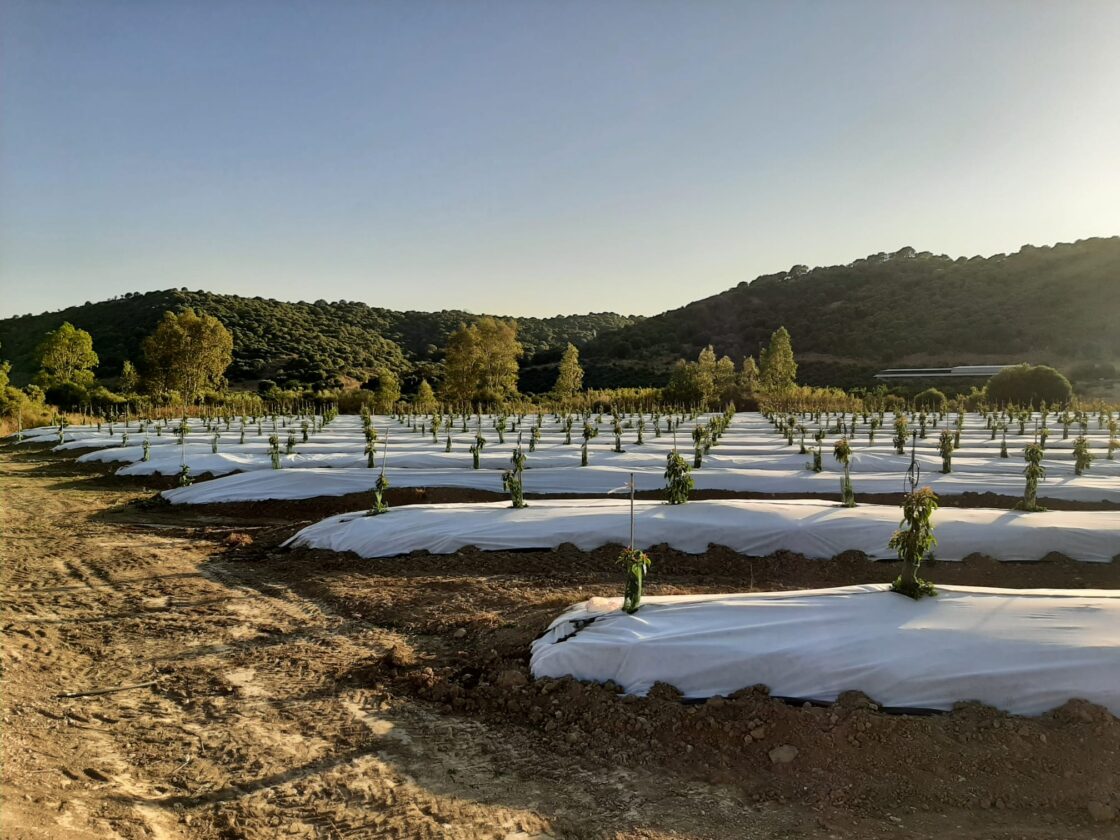
How DNT Agro’s double-layer weed control fabric contributes to water savings
The key is not just in “covering the soil,” but in how it is covered. The double-layer structure makes a clear difference compared to conventional solutions.
Reduction of evaporation
The fabric acts as a protective layer that:
- Reduces direct soil exposure to the sun
- Decreases moisture loss through evaporation
- Keeps water available for longer
This allows irrigation intervals to be extended.
Soil moisture conservation
By stabilizing temperature and protecting the surface:
- The soil retains more consistent moisture
- Dry spikes after irrigation are avoided
- Roots operate in a more balanced environment
Elimination of water competition
Without weeds:
- The water applied is used exclusively by the crop
- The need to increase irrigation doses is reduced
- Overall system efficiency improves
Drip irrigation optimization
The double-layer weed control fabric is fully compatible with localized irrigation:
- Prevents losses from runoff
- Keeps the root zone moist
- Maximizes the efficiency of each dripper
Soil microclimate effect
The combination of protection and breathability creates:
- Less water stress
- Greater soil stability
- Better conditions for root development
All of this translates into less water needed for the same or even better crop performance.
Crops where water savings are most significant
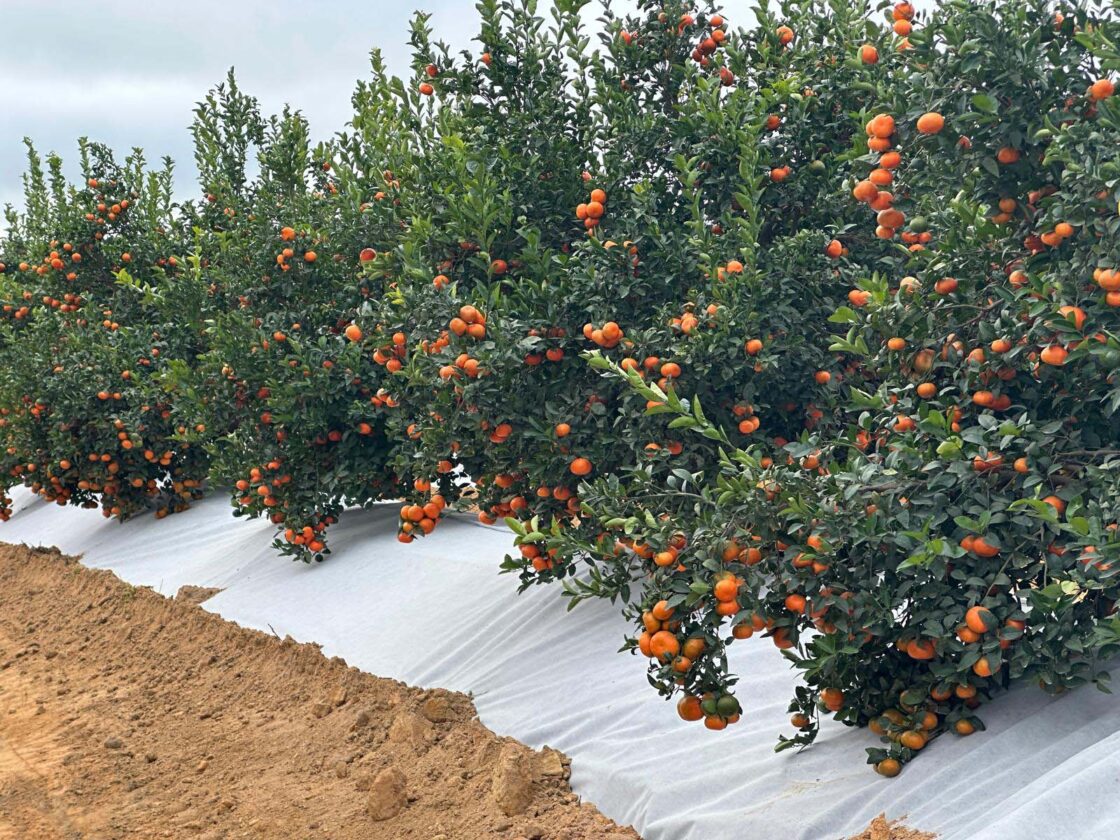
DNT Agro’s double-layer weed control fabric shows particularly significant results in:
Fruit trees
- Weed control in planting rows
- Drip irrigation optimization
- Reduced evaporation during critical periods
Vineyard
- Improved water efficiency in dry climates
- Reduced competition in young vines
Olive groves
- Moisture conservation in exposed soils
- Reduced irrigation frequency in intensive systems
Nurseries and greenhouses
- Maximum environmental control
- Significant reduction in water consumption
Water savings = economic savings
The impact is not only agronomic, but also financial.
Fewer irrigations
- Lower total volume of water applied
- Fewer operating hours of the irrigation system
Lower energy consumption
- Reduced electricity or fuel costs
- Less wear on pumps and systems
Medium- and long-term profitability
Although weed control fabric requires an initial investment, its durability and continuous effect generate:
- Accumulated water savings
- Reduced operational costs
- Greater production stability
Frequently asked questions about weed control fabric and water savings
How much water can be saved with a weed control fabric?
It depends on the crop and irrigation system, but under normal conditions, the savings are significant by reducing evaporation and water competition.
Does it affect crop growth?
No. On the contrary, it improves soil conditions and promotes more balanced development.
Is it compatible with drip irrigation?
Yes. It is specifically designed to maximize the efficiency of localized irrigation.
How long does professional weed control fabric last?
DNT Agro’s double-layer fabric is manufactured for intensive and prolonged agricultural use, withstanding demanding conditions.
Is the investment worthwhile?
When considering savings in water, energy, and labor, the profitability is clear from both a technical and economic perspective.
If you want to learn more about the technical features and applications of this solution, we invite you to explore DNT Agro’s double-layer weed control fabric and see how it can be adapted to your cropping system.